

Rational And Irrational Numbers Quiz
Latest Rational or Irrational Numbers MCQ Objective Questions
Rational or Irrational Numbers MCQ Question i:
Which of the following fraction can exist written every bit a Non-terminating decimal?
Reply (Detailed Solution Below)
Option 1 : \(vii \over18 \)
Given:
The three fractions are 7/eighteen, eleven/250, 21/28
Concept used:
Terminating decimal: A terminating decimal has an finish digit that has a finite number of digits or terms.
Adding:
7/18 = 0.38888... =\(0.3\bar8\) (Non terminating decimal)
11/250 = 0.044 (Terminating decimal)
21/28 = 0.75 (Terminating decimal)
Hence, pick ane is the correct respond.
 Important Points
Theorem:
- Let x exist a rational number whose simplest form is p/q, where p and q are integers and q ≠ 0.
- Then, 10 is a terminating decimal only when q is of the form2grand x 5n for some non-negative integers thou and n.
 Additional Information
Rational Numbers:
- A number of the course p/q, where p and q are integers and q ≠ 0 are called rational numbers.
- Square roots of prime numbers are irrational
Rational or Irrational Numbers MCQ Question 2:
If the numerator of a fraction is increased past 150% and the denominator of a fraction is increased by 200%, the fraction becomes x/19. Observe the fraction.
Answer (Detailed Solution Below)
Pick two : 12/19
Given:
The numerator is increased by 150%
The denominator is increased by 200%
Last fraction = 10/19
Concept used:
Percentage increase of a quantity = Initial quantity × (one + percentage change)
Calculation:
Let the fraction be x/y
⇒ (x + 250%)/(y + 300%) = x/nineteen
⇒ 250x/300y = ten/nineteen
⇒ ten/y = 10/19 × 300/250
⇒ x/y = 12/19
∴ The fraction is 12/19.
Rational or Irrational Numbers MCQ Question iii:
The numerator of a rational number is less than its denominator past 10. If the numerator is increased by 12 and denominator is decreased by 5, then the obtained is\(\frac{5}{4}\). Find the rational number.
Answer (Detailed Solution Beneath)
Pick 3 : \(\frac{23}{33}\)
Solution:
Let assume that the rational number is " 10/y "
according to the question : x + 10 = y ........... Eq (1)
afterward increasing 12 in numerator and decreasing 5 in denominator
⇒( x + 12 ) / ( y - 5 ) = 5/iv
4x + 48 = 5y - 25
4x - 5y = - 73 ................. Eq (two)
by solving the Eq 1. & Eq ii.
4x - v (x + x) = -73
we get that
⇒Y = 33
⇒10 = 23
Here the required rational number is : 23/33
Hence , the correct answer is "23/33".
Rational or Irrational Numbers MCQ Question 4:
Consider the following statements in respect of ii integers p and q (both ane) which are relatively prime:
i. Both p and q may be prime numbers.
2. Both p and q may be blended numbers.
iii. I of p and q may be prime and the other composite.
Which of the to a higher place statements are right?
Reply (Detailed Solution Below)
Option 3 : i and 3 only
The correct respond is: i and iii only
Rational or Irrational Numbers MCQ Question 5:
\(0.\overline{23}\) is equal to :
Answer (Detailed Solution Below)
Option 2 : \(\frac{23}{99}\)
Calculation:
Allow x = 0.23--(i)
Multiply 100 on both side of equation (i),
⇒ 100x = 23.23....(2)
Decrease the equation (i) from (two),
⇒ 99x = 23
x = 23/99
∴\(0.\overline{23}\)= 23/99
Pinnacle Rational or Irrational Numbers MCQ Objective Questions
Write 0.135135.... in the course of p/q.
Answer (Detailed Solution Below)
Option i : 5/37
Given:
0.135135....
Concept used:
The numbers of the form (p/q), where q ≠ 0 and p and q is integer is known as rational number.
Calculation:
Let ten = 0.135135.... ----(1)
Multiply equation (1) by 1000, we have
1000x = 135.135.... ----(2)
Subtract equation (1) from equation (2), nosotros accept
1000x - ten = (135.135...) - (0.135135....)
⇒ 999x = 135
⇒ ten = 135/999
⇒ x = 45/333
⇒ ten = 5/37
∴ The 0.135135.... can be written as 5/37 in the form of p/q.
Which of the following numbers will accept an irrational square root?
Reply (Detailed Solution Below)
Option 2 : 6025
⇒ 11025 = 52 × 212
⇒ 6025 = 5ii × 241
⇒ 9025 = vtwo × 192
⇒ 3025 = 52 × 11two
∴ 6025 will have irrational square root.
Which of the post-obit rational numbers does not prevarication between 3/v and 4/5?
Answer (Detailed Solution Below)
Option iv : 16/thirty
Calculation:
Taking all the fractions,
3/five, 4/5, 19/30, 2/3, 7/ten, 16/30
Taking LCM of the denominator
LCM of (5, 5, xxx, 3, 10 and 30) = 30
Converting all the denominators to 30
3/five tin be written equally 18/30
4/5 can exist written as 24/30
19/30 can be written equally 19/30
two/iii can be written as 20/30
seven/x can be written as 21/30
16/30 can be written every bit 16/30
Representing this on the number line
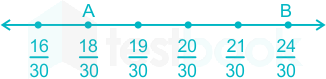
So,
∴ 16/30 does not lie betwixt 3/v and four/five.
What is the value of \(\sqrt {19 + 8\sqrt 3 } = ?\)
Answer (Detailed Solution Below)
Option one : \(four + \sqrt three \)
\(\brainstorm{assortment}{l} \sqrt {19 + 8\sqrt three } \\ = \sqrt {16 + 3 + 8\sqrt iii } \\ = \sqrt {{4^2} + {{\left( {\sqrt 3 } \right)}^2} + 2\; \times \;4\; \times \;\sqrt 3 } \finish{assortment}\)
∵ a2+ b2 + 2ab = (a + b)2
\(= \sqrt {{{\left( {4 + \sqrt 3 } \right)}^2}} \)
= 4 + √ three
How many factors of number 4000 are perfect squares?
Answer (Detailed Solution Below)
Option four : 6
Factors of 4000 = i, 2, iv, 5, 8, 10, xvi, 20, 25, 32, forty, fifty, eighty, 100, 125, 160, 200, 250, 400, 500, 800, 1000, 2000, 4000
The factors which are perfect squares = 1, four, 16, 25, 100, 400.
∴ the required number is 6
Betwixt two rational numbers
Reply (Detailed Solution Below)
Option 3 : there are infinitely many rational numbers
Concept used:
A rational number is a number that is expressed as the ratio of two integers, where the denominator should non be equal to zero.
Calculation:
Fiftyet, here we accept ii rational numbers 1/5 and 1/2
Then, rational numbers between and 7/20, 8/20, 9/20, 21/100, 22/100, 23/100, 24/100,...
Between 2 rational numbers, there are infinitely many rational numbers.
∴ Between ii rational numbers, there are infinitely many rational numbers.
Which of the following is the rational course of \(one.02{\bar3}\) ?
Respond (Detailed Solution Below)
Option 1 : \(\frac{{307}}{{300}}\)
 Shortcut Fob
We can solve this question past brusk method:
Write the number and subtract the non-repeated office and carve up the result by as many every bit nine as echo part followed by and as many as 0 every bit non-repeating decimal
⇒\(one.02{\bar3}\) = (1023 - 102)/900
⇒\(1.02{\bar3}\) = 921/900
⇒\(one.02{\bar3}\) = 307/300
∴ The rational class of\(1.02{\bar3}\) is 307/300.
Traditional method:
Given:
Given number is\(1.02{\bar3}\)
Adding
Let x = 1.02333.... ----(1)
multiply equation (1) past 100, nosotros get
⇒ 100x = 102.333.... ----(2)
multiply equation (2) past 10, nosotros get
⇒ 1000x = 1023.333.... ----(3)
Now, Subtracting equation (2) from equation (three), we get
⇒ 900x = 921
Divide each term by iii, we go
⇒ 300x = 307
⇒ ten = 307/300
∴ The rational form of\(ane.02{\bar3}\) is 307/300.
Which of the following is equivalent to \(0.\overline {56} \)? (the bar indicates repeating decimal)
Answer (Detailed Solution Below)
Selection 3 : 56/99
Given:
\(0.\overline {56} \) = ?
Calculations:
Let 10 = 0.56565656..... (i)
100x = 56.565656.... (ii)
Equation (two) - Equation (i)
99x = 56
∴ ten = 56/99
A number\({2.\overline{35}}\) is:
Answer (Detailed Solution Below)
Option one : a rational number
Given:
Number =\({two.\overline{35}}\)
Concept used:
A number is rational if and only if its decimal representation is repeating or terminating.
Detailed solution:
\({2.\overline{35}}\) is a repeating decimal (∵\({2.\overline{35}} = 2.3535353535...\))
∴ The given number\({two.\overline{35}}\) is a rational number
Additional Information A number is irrational if and only if its decimal representation is non-terminating and non-repeating.
Whatsoever number which cannot be written in the form of p/q is termed an irrational number.
While \({2.\overline{35}}\) is a rational number as it can be changed to p/q class,
→\({two.\overline{35}}\)= 233/99
Which of the following is not an irrational number?
Respond (Detailed Solution Below)
Option 3 : √4
Concept used:
Irrational numbers are those numbers which accept decimal expansion that neither terminating nor repeating.
Calculation:
Like π = 3.1415926…….
√2 = 1.41421….
√3 = i.73205……
But √4 = 2
∴ √4 is not an irrational number
All rational numbers are ______ numbers.
Answer (Detailed Solution Below)
Pick 4 : real
Arational number is anumber that can be expressed as the quotient or fraction p/q of 2 integers, a numerator p, and a not-naught denominator q.
Real numbers are numbers comprising rational and irrational numbers
∴ We empathise that allrational numbers are existent numbers.
Which is the smallest natural number having exactly 10 factors?
Answer (Detailed Solution Beneath)
Option 4 : 48
In this question we tin go through the options,
Factors of 36 = ane,2,3,iv,half-dozen,9,12,eighteen,36
24 = i,two,3,4,6,8,12,24
16 = i,two,iv,eight,16
48 = one,2,iii,four,half-dozen,viii,12,16,24,48
Hence the right option is 48.
If √two = 1.4, the value of\(\sqrt {98}\) is:
Respond (Detailed Solution Below)
Option 2 : ix.8
Given:
\({\sqrt2}\) = 1.4 We have to find the value of\(\sqrt {98}\)
Calculation:
98 = 2 × vii × 7
\(\sqrt {98}\) = √(2 × 7 × 7)
⇒\(\sqrt {98}\) = seven√2
⇒\(\sqrt {98}\) = 7 × 1.iv [∵ √2 = 1.four given]
⇒\(\sqrt {98}\) = 9.8
∴ The value of\(\sqrt {98}\) is 9.8
Limited X = 0.456666.... as a fraction
Answer (Detailed Solution Below)
Option 3 : 411/900
Calculation:
10 = 0.456666.... -(i)
Multiply by 100 in equation (i)
100X = 45 + 0.6666.... -(two)
Multiply by 1000 in equation (i)
1000X = 456 + 0.6666.... -(3)
Subtract equation (ii) from equation (iii)
900X = 411
∴ X = 411/900
Discover the irrational number.
Respond (Detailed Solution Below)
Pick three : (4096) one / viii
CALCULATIONS:
4096 = 64two = ii12
Pick 1: (4096) 1 / 3 → (212)i / 3 = 24 = 16 → not irrational number
Option 2: (4096) 1 / iv → (212)one / 4 = 23 = 8 → non irrational number
Option 4: (4096) 1 / 6 → (212)1 / 6 = iitwo = 4 → not irrational number
Selection 3: (4096) 1 / viii → (ii12)one / 8 = 23 / two → irrational number
∴ (4096) 1 / 8 is irrational number.
Give the expression of\(8.\overline{48}\)
Answer (Detailed Solution Beneath)
Option 2 : \(\frac{840}{99}\)
Adding:
(a)Let 10 =\(8.\overline{48}\)
⇒ x = 8.4848484848.........
By multiplying both sides by 100.
(b)100x =\(848.\overline{48}\)
At present, by subtracting (a) from (b), nosotros become 99x = 840
⇒ x = 840/99
∴\(eight.\overline{48}\) = 840/99
Which of the following numbers is irrational?
Answer (Detailed Solution Beneath)
Option 2 : \(\sqrt[iv]{{1024}}\)
⇒ (1024)(ane/ten) = (210)(one/10) = 2
⇒ (1024)(1/4) = (210)(ane/iv) = four × two(1/iv)
⇒ (1024)(1/2) = (322)(1/2) = 32
⇒ (1024)(1/five) = (4five)(i/five) = 4
∴ \(\sqrt[4]{{1024}}\) is irrational.
Right expression of\(0.06\overline {54}\). (the bar indicates repeating decimal)
Respond (Detailed Solution Below)
Pick ane : \(\frac{eighteen}{275}\)
Calculation:
Let x = \(0.06\overline {54}\)
⇒ ten = 0.065454
⇒ 100x = six.5454
⇒ 100x - x = 6.5454 - 0.0654
⇒ 99x = half dozen.48
⇒ x = half-dozen.48/99
⇒ xviii/275
\({{three\sqrt5 + \sqrt5} \over {iii\sqrt5 - \sqrt5}} = ii + b\sqrt5\) Observe the value of b
Answer (Detailed Solution Below)
Option 2 : 0
Given:
\({{3√v + √5} \over {three√v - √5}} = 2 + b√5\)
Concept Used:
Concept of rationalization
Adding:
\(⇒ {({3√five + √5}) \times ({iii√5 + √5}) \over ({3√5 - √5}) \times ({3√5 + √v})}\)
\(⇒ {({iii√5)^2 + (√v})^ii + 2 \times 3√5 \times √5 \over {(45 - 5)}}\)
⇒ (45 + 5 + 30)/40
⇒ lxxx/40
⇒ 2
Comparison 2 with 2 + b√5 become b = 0 [∵ Rational part is 0]
∴ The required value of b is 0.

\({{3√5 + √5} \over {three√5 - √5}} = 2 + b√v\)
⇒ (4√5)/(2√v) = 2 + b√5
⇒ 2 = 2 + b√v
⇒ b = 0
∴ The required value of b is 0.
'π' is
Answer (Detailed Solution Below)
Option 4 : An irrational number
π = (3.14159265359...) is an irrational number as information technology tin non exist expressed in the form of p/q, where p and q are integers and q ≠ 0
Additional Information
Rational Number: A rational number is a number that can exist expressed in the form of p/q where p and q are integers and q ≠ 0.
Example:
6 = 6/1 =12/2
0.5 = v/10 = ½
-0.675 = -675/g = 27/40
10/three = 3.333…
Irrational Number:A irrational number is a number that cannot be expressed in the form of p/q where p and q are integers and q ≠ 0
Example:
π = (iii.14159265359...)
√2, √3
Prime∶A prime number is a positive integer greater than one, that can just be exactly divided by the positive integer 1 and itself without leaving a remainder.
Example: 2, 3, five, 7
Integer∶An integer is a number that has no partial part and it tin can be positive, negative or nothing.
Example: -1, 0, 1, 2, 3

Rational And Irrational Numbers Quiz,
Source: https://testbook.com/objective-questions/mcq-on-rational-or-irrational-numbers--5eea6a1039140f30f369e844
Posted by: sampleancyingums.blogspot.com
0 Response to "Rational And Irrational Numbers Quiz"
Post a Comment