| OEIS link | Proper noun | Starting time elements | Short description |
| A000002 | Kolakoski sequence | {1, ii, 2, 1, ane, two, 1, two, 2, 1, ...} | The n th term describes the length of the n th run |
| A000010 | Euler'southward totient function φ(due north) | {one, 1, 2, ii, 4, 2, half-dozen, 4, 6, four, ...} | φ(northward) is the number of positive integers not greater than northward that are coprime with due north . |
| A000032 | Lucas numbers L(northward) | {ii, 1, iii, 4, 7, 11, eighteen, 29, 47, 76, ...} | L(n) = 50(n − 1) + 50(n − ii) for n ≥ two, with 50(0) = ii and L(1) = 1. |
| A000040 | Prime numbers p north | {2, 3, 5, 7, 11, 13, 17, 19, 23, 29, ...} | The prime numbers p n , with n ≥ 1. A prime number is a natural number greater than 1 that is not a product of 2 smaller natural numbers. |
| A000041 | Segmentation numbers
P n | {i, ane, 2, 3, 5, vii, 11, xv, 22, xxx, 42, ...} | The partition numbers, number of additive breakdowns of n. |
| A000045 | Fibonacci numbers F(n) | {0, ane, 1, 2, iii, v, 8, 13, 21, 34, ...} | F(n) = F(northward − 1) + F(northward − ii) for n ≥ ii, with F(0) = 0 and F(1) = ane. |
| A000058 | Sylvester's sequence | {ii, 3, seven, 43, 1807, 3263443, 10650056950807, 113423713055421844361000443, ...} | a(n + 1) = a(north)⋅a(n − 1)⋅ ⋯ ⋅a(0) + 1 = a(due north)2 − a(due north) + 1 for n ≥ 1, with a(0) = 2. |
| A000073 | Tribonacci numbers | {0, 1, 1, ii, 4, 7, xiii, 24, 44, 81, ...} | T(n) = T(n − 1) + T(n − 2) + T(north − three) for n ≥ iii, with T(0) = 0 and T(1) = T(2) = 1. |
| A000079 | Powers of 2 | {1, ii, 4, viii, 16, 32, 64, 128, 256, 512, 1024, ...} | Powers of 2: 2 due north for due north ≥ 0 |
| A000105 | Polyominoes | {ane, one, 1, 2, 5, 12, 35, 108, 369, ...} | The number of complimentary polyominoes with n cells. |
| A000108 | Catalan numbers C northward | {1, i, 2, 5, 14, 42, 132, 429, 1430, 4862, ...} |  |
| A000110 | Bell numbers B due north | {1, 1, 2, 5, 15, 52, 203, 877, 4140, 21147, ...} | B northward is the number of partitions of a set with northward elements. |
| A000111 | Euler zigzag numbers E n | {1, one, i, ii, 5, 16, 61, 272, 1385, 7936, ...} | E northward is the number of linear extensions of the "zig-zag" poset. |
| A000124 | Lazy caterer's sequence | {1, two, 4, 7, xi, 16, 22, 29, 37, 46, ...} | The maximal number of pieces formed when slicing a pancake with n cuts. |
| A000129 | Pell numbers P n | {0, 1, 2, 5, 12, 29, 70, 169, 408, 985, ...} | a(northward) = 2a(n − one) + a(n − 2) for north ≥ 2, with a(0) = 0, a(ane) = ane. |
| A000142 | Factorials n! | {i, 1, 2, 6, 24, 120, 720, 5040, 40320, 362880, ...} | north! = 1⋅2⋅3⋅4⋅ ⋯ ⋅northward for n ≥ ane, with 0! = 1 (empty product). |
| A000166 | Derangements | {1, 0, one, 2, nine, 44, 265, 1854, 14833, 133496, 1334961, 14684570, 176214841, ...} | Number of permutations of n elements with no fixed points. |
| A000203 | Divisor function σ(n) | {ane, 3, 4, seven, 6, 12, 8, 15, thirteen, eighteen, 12, 28, ...} | σ(northward) := σ 1(n) is the sum of divisors of a positive integer n . |
| A000215 | Fermat numbers F n | {iii, 5, 17, 257, 65537, 4294967297, 18446744073709551617, 340282366920938463463374607431768211457, ...} | F n = 2 2 n + i for due north ≥ 0. |
| A000238 | Polytrees | {ane, 1, 3, 8, 27, 91, 350, 1376, 5743, 24635, 108968, ...} | Number of oriented trees with north nodes. |
| A000396 | Perfect numbers | {six, 28, 496, 8128, 33550336, 8589869056, 137438691328, 2305843008139952128, ...} | north is equal to the sum s(northward) = σ(n) − north of the proper divisors of n . |
| A000594 | Ramanujan tau part | {ane,−24,252,−1472,4830,−6048,−16744,84480,−113643...} | Values of the Ramanujan tau function, τ(n) at due north = ane, two, 3, ... |
| A000793 | Landau's function | {i, 1, 2, three, 4, half-dozen, 6, 12, 15, 20, ...} | The largest order of permutation of n elements. |
| A000930 | Narayana's cows | {1, 1, 1, 2, 3, 4, 6, 9, xiii, nineteen, ...} | The number of cows each year if each cow has 1 cow a twelvemonth outset its fourth year. |
| A000931 | Padovan sequence | {1, ane, ane, 2, 2, 3, 4, 5, 7, 9, ...} | P(northward) = P(n − 2) + P(n − 3) for northward ≥ three, with P(0) = P(ane) = P(2) = i. |
| A000945 | Euclid–Mullin sequence | {two, 3, vii, 43, 13, 53, five, 6221671, 38709183810571, 139, ...} | a(1) = 2; a(north + one) is smallest prime factor of a(ane) a(2) ⋯ a(n) + 1. |
| A000959 | Lucky numbers | {one, iii, 7, 9, 13, 15, 21, 25, 31, 33, ...} | A natural number in a ready that is filtered past a sieve. |
| A000961 | Prime powers | {1, 2, 3, 4, v, 7, 8, 9, eleven, xiii, 16, 17, 19, ...} | Positive integer powers of prime number numbers |
| A000984 | Fundamental binomial coefficients | {1, 2, half dozen, 20, lxx, 252, 924, ...} | 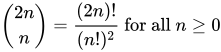 , numbers in the centre of even rows of Pascal's triangle , numbers in the centre of even rows of Pascal's triangle |
| A001006 | Motzkin numbers | {1, i, 2, 4, nine, 21, 51, 127, 323, 835, ...} | The number of means of cartoon whatever number of nonintersecting chords joining north (labeled) points on a circle. |
| A001013 | Hashemite kingdom of jordan–Pólya numbers | {one, two, iv, 6, 8, 12, 16, 24, 32, 36, 48, 64. ...} | Numbers that are the product of factorials. |
| A001045 | Jacobsthal numbers | {0, 1, 1, 3, v, 11, 21, 43, 85, 171, 341, ...} | a(n) = a(due north − 1) + iia(n − ii) for north ≥ ii, with a(0) = 0, a(1) = one. |
| A001065 | Sum of proper divisors s(n) | {0, 1, one, 3, ane, 6, 1, vii, 4, 8, ...} | s(n) = σ(north) − due north is the sum of the proper divisors of the positive integer n . |
| A001190 | Wedderburn–Etherington numbers | {0, ane, 1, 1, 2, iii, vi, xi, 23, 46, ...} | The number of binary rooted trees (every node has out-degree 0 or ii) with northward endpoints (and 2n − one nodes in all). |
| A001316 | Gould'due south sequence | {1, 2, two, 4, two, 4, 4, 8, 2, 4, 4, 8, 4, 8, viii, ...} | Number of odd entries in row n of Pascal's triangle. |
| A001358 | Semiprimes | {iv, 6, 9, ten, xiv, 15, 21, 22, 25, 26, ...} | Products of ii primes, not necessarily distinct. |
| A001462 | Golomb sequence | {1, ii, 2, 3, 3, 4, 4, iv, 5, 5, ...} | a(northward) is the number of times n occurs, starting with a(1) = 1. |
| A001608 | Perrin numbers P northward | {3, 0, 2, 3, ii, v, 5, seven, 10, 12, ...} | P(northward) = P(n−ii) + P(n−three) for north ≥ iii, with P(0) = three, P(1) = 0, P(2) = 2. |
| A001855 | Sorting number | {0, 1, 3, 5, 8, 11, 14, 17, 21, 25, 29, 33, 37, 41, 45, 49 ...} | Used in the analysis of comparison sorts. |
| A002064 | Cullen numbers C n | {1, three, 9, 25, 65, 161, 385, 897, 2049, 4609, 10241, 22529, 49153, 106497, ...} | C n = north⋅2 n + 1, with n ≥ 0. |
| A002110 | Primorials p north # | {1, 2, vi, thirty, 210, 2310, 30030, 510510, 9699690, 223092870, ...} | p n #, the product of the commencement n primes. |
| A002182 | Highly composite numbers | {1, 2, 4, 6, 12, 24, 36, 48, lx, 120, ...} | A positive integer with more divisors than any smaller positive integer. |
| A002201 | Superior highly composite numbers | {2, vi, 12, sixty, 120, 360, 2520, 5040, 55440, 720720, ...} | A positive integer n for which there is an e > 0 such that d(north) / north e ≥ d(thousand) / k e for all g > ane. |
| A002378 | Pronic numbers | {0, 2, 6, 12, 20, thirty, 42, 56, 72, 90, ...} | a(n) = 2t(n) = n(n + i), with north ≥ 0 where t(due north) are the triangular numbers. |
| A002559 | Markov numbers | {one, 2, 5, 13, 29, 34, 89, 169, 194, ...} | Positive integer solutions of x 2 + y 2 + z 2 = iiixyz . |
| A002808 | Blended numbers | {iv, six, 8, ix, ten, 12, 14, 15, 16, xviii, ...} | The numbers n of the form xy for x > 1 and y > 1. |
| A002858 | Ulam number | {ane, 2, 3, 4, vi, 8, eleven, 13, 16, xviii, ...} | a(1) = 1; a(2) = two; for northward > 2, a(n) is least number > a(n − 1) which is a unique sum of 2 distinct before terms; semiperfect. |
| A002863 | Prime knots | {0, 0, 1, 1, ii, 3, seven, 21, 49, 165, 552, 2176, 9988, ...} | The number of prime knots with due north crossings. |
| A002997 | Carmichael numbers | {561, 1105, 1729, 2465, 2821, 6601, 8911, 10585, 15841, 29341, ...} | Composite numbers n such that a n − 1 ≡ 1 (mod n) if a is coprime with n . |
| A003261 | Woodall numbers | {1, seven, 23, 63, 159, 383, 895, 2047, 4607, ...} | northward⋅two due north − ane, with northward ≥ i. |
| A003601 | Arithmetic numbers | {1, 3, v, six, seven, 11, 13, 14, 15, 17, 19, 20, 21, 22, 23, 27, ...} | An integer for which the average of its positive divisors is also an integer. |
| A004490 | Colossally arable numbers | {2, 6, 12, sixty, 120, 360, 2520, 5040, 55440, 720720, ...} | A number n is colossally abundant if there is an ε > 0 such that for all 1000 > i, -
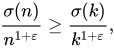 where σ denotes the sum-of-divisors office. |
| A005044 | Alcuin's sequence | {0, 0, 0, 1, 0, 1, one, ii, one, 3, ii, 4, 3, 5, 4, seven, 5, 8, 7, 10, 8, 12, 10, 14, ...} | Number of triangles with integer sides and perimeter northward . |
| A005100 | Deficient numbers | {1, two, 3, 4, five, 7, eight, 9, x, 11, ...} | Positive integers north such that σ(n) < 2n . |
| A005101 | Abundant numbers | {12, 18, xx, 24, 30, 36, 40, 42, 48, 54, ...} | Positive integers north such that σ(n) > 2due north . |
| A005114 | Untouchable numbers | {2, 5, 52, 88, 96, 120, 124, 146, 162, 188, ...} | Cannot exist expressed as the sum of all the proper divisors of whatsoever positive integer. |
| A005132 | Recamán'south sequence | {0, 1, three, 6, 2, seven, 13, 20, 12, 21, 11, 22, 10, 23, 9, 24, 8, 25, 43, 62, ...} | "subtract if possible, otherwise add": a(0) = 0; for n > 0, a(northward) = a(n − 1) − north if that number is positive and not already in the sequence, otherwise a(northward) = a(n − ane) + n, whether or not that number is already in the sequence. |
| A005150 | Look-and-say sequence | {1, 11, 21, 1211, 111221, 312211, 13112221, 1113213211, 31131211131221, 13211311123113112211, ...} | A = 'frequency' followed by 'digit'-indication. |
| A005153 | Practical numbers | {1, 2, iv, 6, viii, 12, 16, 18, 20, 24, 28, 30, 32, 36, 40...} | All smaller positive integers tin can exist represented as sums of distinct factors of the number. |
| A005165 | Alternate factorial | {1, 1, five, 19, 101, 619, 4421, 35899, 326981, 3301819, 36614981, 442386619, 5784634181, 81393657019, ...} | n! − (n−1)! + (n−2)! − ... 1!. |
| A005235 | Fortunate numbers | {3, 5, 7, 13, 23, 17, xix, 23, 37, 61, ...} | The smallest integer 1000 > 1 such that p due north # + grand is a prime number, where the primorial p northward # is the product of the showtime n prime numbers. |
| A005835 | Semiperfect numbers | {6, 12, 18, xx, 24, 28, thirty, 36, xl, 42, ...} | A natural number due north that is equal to the sum of all or some of its proper divisors. |
| A006003 | Magic constants | {15, 34, 65, 111, 175, 260, 369, 505, 671, 870, 1105, 1379, 1695, 2056, ...} | Sum of numbers in any row, column, or diagonal of a magic foursquare of society due north ≥ 3. |
| A006037 | Weird numbers | {70, 836, 4030, 5830, 7192, 7912, 9272, 10430, 10570, 10792, ...} | A natural number that is abundant but not semiperfect. |
| A006842 | Farey sequence numerators | {0, 1, 0, one, 1, 0, ane, 1, 2, 1, ...} | |
| A006843 | Farey sequence denominators | {1, 1, 1, 2, ane, 1, 3, 2, three, ane, ...} | |
| A006862 | Euclid numbers | {two, 3, seven, 31, 211, 2311, 30031, 510511, 9699691, 223092871, ...} | p northward # + 1, i.e. 1 + production of first n consecutive primes. |
| A006886 | Kaprekar numbers | {1, nine, 45, 55, 99, 297, 703, 999, 2223, 2728, ...} | Ten 2 = Ab northward + B , where 0 < B < b n and Ten = A + B . |
| A007304 | Sphenic numbers | {30, 42, 66, lxx, 78, 102, 105, 110, 114, 130, ...} | Products of 3 distinct primes. |
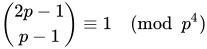
| A007850 | Giuga numbers | {30, 858, 1722, 66198, 2214408306, ...} | Blended numbers so that for each of its singled-out prime number factors p i we have  . . |
| A007947 | Radical of an integer | {one, 2, 3, 2, five, half-dozen, seven, 2, 3, ten, ...} | The radical of a positive integer due north is the product of the singled-out prime numbers dividing n . |
| A010060 | Thue–Morse sequence | {0, one, i, 0, 1, 0, 0, 1, ane, 0, ...} | |
| A014577 | Regular paperfolding sequence | {1, 1, 0, 1, 1, 0, 0, 1, i, one, ...} | At each stage an alternating sequence of 1s and 0s is inserted betwixt the terms of the previous sequence. |
| A016105 | Blum integers | {21, 33, 57, 69, 77, 93, 129, 133, 141, 161, 177, ...} | Numbers of the class pq where p and q are distinct primes coinciding to 3 (modern 4). |
| A018226 | Magic numbers | {2, eight, 20, 28, 50, 82, 126, ...} | A number of nucleons (either protons or neutrons) such that they are arranged into consummate shells within the atomic nucleus. |
| A019279 | Superperfect numbers | {2, 4, sixteen, 64, 4096, 65536, 262144, 1073741824, 1152921504606846976, 309485009821345068724781056, ...} | Positive integers north for which σ 2(due north) = σ(σ(n)) = iin. |
| A027641 | Bernoulli numbers B n | {1, −1, one, 0, −1, 0, 1, 0, −one, 0, 5, 0, −691, 0, seven, 0, −3617, 0, 43867, 0, ...} | |
| A034897 | Hyperperfect numbers | {vi, 21, 28, 301, 325, 496, 697, ...} | grand -hyperperfect numbers, i.e. n for which the equality n = 1 + k (σ(n) − n − i) holds. |
| A052486 | Achilles numbers | {72, 108, 200, 288, 392, 432, 500, 648, 675, 800, ...} | Positive integers which are powerful but imperfect. |
| A054377 | Master pseudoperfect numbers | {2, 6, 42, 1806, 47058, 2214502422, 52495396602, ...} | Satisfies a certain Egyptian fraction. |
| A059756 | Erdős–Forest numbers | {xvi, 22, 34, 36, 46, 56, 64, 66, 70, 76, 78, 86, 88, ...} | The length of an interval of consecutive integers with holding that every element has a factor in mutual with ane of the endpoints. |
| A076336 | Sierpinski numbers | {78557, 271129, 271577, 322523, 327739, 482719, 575041, 603713, 903983, 934909, ...} | Odd k for which { k⋅2 n + one : n ∈  } consists only of blended numbers. } consists only of blended numbers. |
| A076337 | Riesel numbers | {509203, 762701, 777149, 790841, 992077, ...} | Odd k for which { k⋅2 due north − 1 : n ∈ } consists but of blended numbers. |
| A086747 | Baum–Sweet sequence | {1, 1, 0, 1, 1, 0, 0, 1, 0, one, ...} | a(n) = 1 if the binary representation of due north contains no block of consecutive zeros of odd length; otherwise a(n) = 0. |
| A090822 | Gijswijt'due south sequence | {1, ane, 2, 1, 1, 2, 2, 2, 3, 1, ...} | The n th term counts the maximal number of repeated blocks at the terminate of the subsequence from 1 to n−1 |
| A093112 | Carol numbers | {−1, 7, 47, 223, 959, 3967, 16127, 65023, 261119, 1046527, ...} |  |
| A094683 | Juggler sequence | {0, 1, i, 5, two, 11, 2, 18, 2, 27, ...} | If n ≡ 0 (mod 2) then ⌊√ n ⌋ else ⌊n 3/2⌋. |
| A097942 | Highly totient numbers | {1, 2, 4, eight, 12, 24, 48, 72, 144, 240, ...} | Each number k on this listing has more than solutions to the equation φ(x) = k than whatsoever preceding k . |
| A122045 | Euler numbers | {1, 0, −one, 0, 5, 0, −61, 0, 1385, 0, ...} | 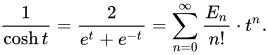 |
| A138591 | Polite numbers | {3, 5, six, 7, ix, 10, xi, 12, thirteen, 14, 15, 17, ...} | A positive integer that can be written as the sum of two or more than consecutive positive integers. |
| A194472 | Erdős–Nicolas numbers | {24, 2016, 8190, 42336, 45864, 392448, 714240, 1571328, ...} | A number n such that in that location exists another number k and 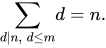 |
| A337663 | Solution to Stepping Rock Puzzle | {1, sixteen, 28, 38, 49, 60 ...} | The maximal value a(n) of the stepping rock puzzle |




0 Response to "6 9 12 15 Sequence"
Post a Comment