

2 2 3 3 Tetramethylbutane
 | |
 | |
| Names | |
|---|---|
| Preferred IUPAC name ii,2,iii,3-Tetramethylbutane[1] | |
| Identifiers | |
| CAS Number |
|
| 3D model (JSmol) |
|
| ChemSpider |
|
| ECHA InfoCard | 100.008.961 |
| EC Number |
|
| PubChem CID |
|
| UNII |
|
| UN number | 1325 |
| CompTox Dashboard (EPA) |
|
| InChI
| |
| SMILES
| |
| Backdrop | |
| Chemic formula | C 8 H xviii |
| Tooth mass | 114.232 k·mol−1 |
| Appearance | White, opaque, waxy crystals |
| Odor | Odorless |
| Melting indicate | 98 to 104 °C; 208 to 219 °F; 371 to 377 K |
| Boiling signal | 106.0 to 107.0 °C; 222.7 to 224.5 °F; 379.1 to 380.ane K |
| Henry'south law | two.9 nmol Pa−one kg−i |
| Thermochemistry | |
| Heat capacity (C) | 232.2 J Thou−1 mol−ane (at ii.8 °C) |
| Std molar | 273.76 J K−1 mol−one |
| Std enthalpy of | −270.three – −267.9 kJ mol−1 |
| Std enthalpy of | −5.4526 – −5.4504 MJ mol−1 |
| Hazards | |
| GHS labelling: | |
| Pictograms |     |
| Indicate word | Danger |
| Hazard statements | H228, H304, H315, H336, H410 |
| Precautionary statements | P210, P240, P241, P261, P264, P271, P273, P280, P301+P310, P302+P352, P304+P340, P312, P321, P331, P332+P313, P362, P370+P378, P391, P403+P233, P405, P501 |
| Flash indicate | four °C (39 °F; 277 K) |
| Explosive limits | one–?% |
| Related compounds | |
| Related alkanes |
|
| Except where otherwise noted, data are given for materials in their standard state (at 25 °C [77 °F], 100 kPa). Infobox references | |


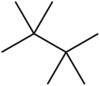
Tetramethylbutane, sometimes called hexamethylethane, is a hydrocarbon with formula C8Heighteen or (HthreeC-)3C-C(-CHthree)3. It is the most heavily branched and most compact of the many octane isomers, the only one with a butane (C4) backbone. Because of its highly symmetrical construction, it has a very high melting betoken and a short liquid range; in fact, information technology is the smallest saturated acyclic hydrocarbon that appears as a solid at a room temperature of 25 °C. (Amidst cyclic hydrocarbons, cubane, C8H8 is fifty-fifty smaller and is also solid at room temperature.) It is also the most stable CviiiH18 isomer, with a heat of formation four.18 kcal/mol (17.5 kJ/mol) lower than that of n-octane, a fact that has been attributed to stabilizing dispersive interactions (electron correlation) between the methyl groups (protobranching).[2]
The compound tin be obtained by reaction of Grignard reagent tert-Butylmagnesium bromide with ethyl bromide, or of ethylmagnesium bromide with tert-butyl bromide in the presence of manganese(Ii) ions.[three] This transformation is believed to go through the dimerization of two tert-butyl radicals, which are generated by decomposition of the organomanganese compounds generated in situ.
The full IUPAC proper name of the chemical compound is two,2,3,three-tetramethylbutane, but the numbers are superfluous in this case because at that place is no other possible arrangement of "tetramethylbutane".
References [edit]
- ^ "Hexamethylethane - Compound Summary". PubChem Compound. Usa: National Heart for Biotechnology Information. 26 March 2005. Identification and Related Information. Retrieved xi March 2012.
- ^ Joyce, Justin P.; Shores, Matthew P.; Rappè, Anthony Thou. (2020-07-29). "Protobranching as repulsion-induced attraction: a prototype for geminal stabilization". Physical Chemistry Chemic Physics. 22 (29): 16998–17006. doi:10.1039/D0CP02193H. ISSN 1463-9084.
- ^ M. S. KHARASCH; J. West. HANCOCK; Westward. NUDENBERG; P. O. TAWNEY (1956). "Factors Influencing the Class and Mechanism of Grignard Reactions. XXII. The Reaction of Grignard Reagents with Alkyl Halides and Ketones in the Presence of Manganous Salts". Periodical of Organic Chemistry. 21 (iii): 322–327. doi:x.1021/jo01109a016.

2 2 3 3 Tetramethylbutane,
Source: https://en.wikipedia.org/wiki/Tetramethylbutane
Posted by: sampleancyingums.blogspot.com
0 Response to "2 2 3 3 Tetramethylbutane"
Post a Comment